Learning Physical Operators using Neural Operators
AISTATS, 2026
Paper: Learning Physical Operators using Neural Operators — V. Gopakumar, A. Gray, D. Giles, L. Zanisi, M. J. Kusner, T. Betcke, S. Pamela, M. P. Deisenroth. AISTATS, 2026. · Code
The problem
A neural operator trained end-to-end learns the whole solution map, including the parts we have known analytically for two centuries. That is wasteful in parameters, and it is worse than wasteful in generalisation: a model that has learned diffusion statistically has no reason to keep obeying diffusion outside the distribution it was trained on. Push it to unseen physics and it degrades in ways nothing in the architecture prevents.
Adding a residual penalty — the PINN route — softens this but does not fix it. The physics is a preference expressed through the loss, not a property of the model.
The idea
Split the operator instead of penalising it.
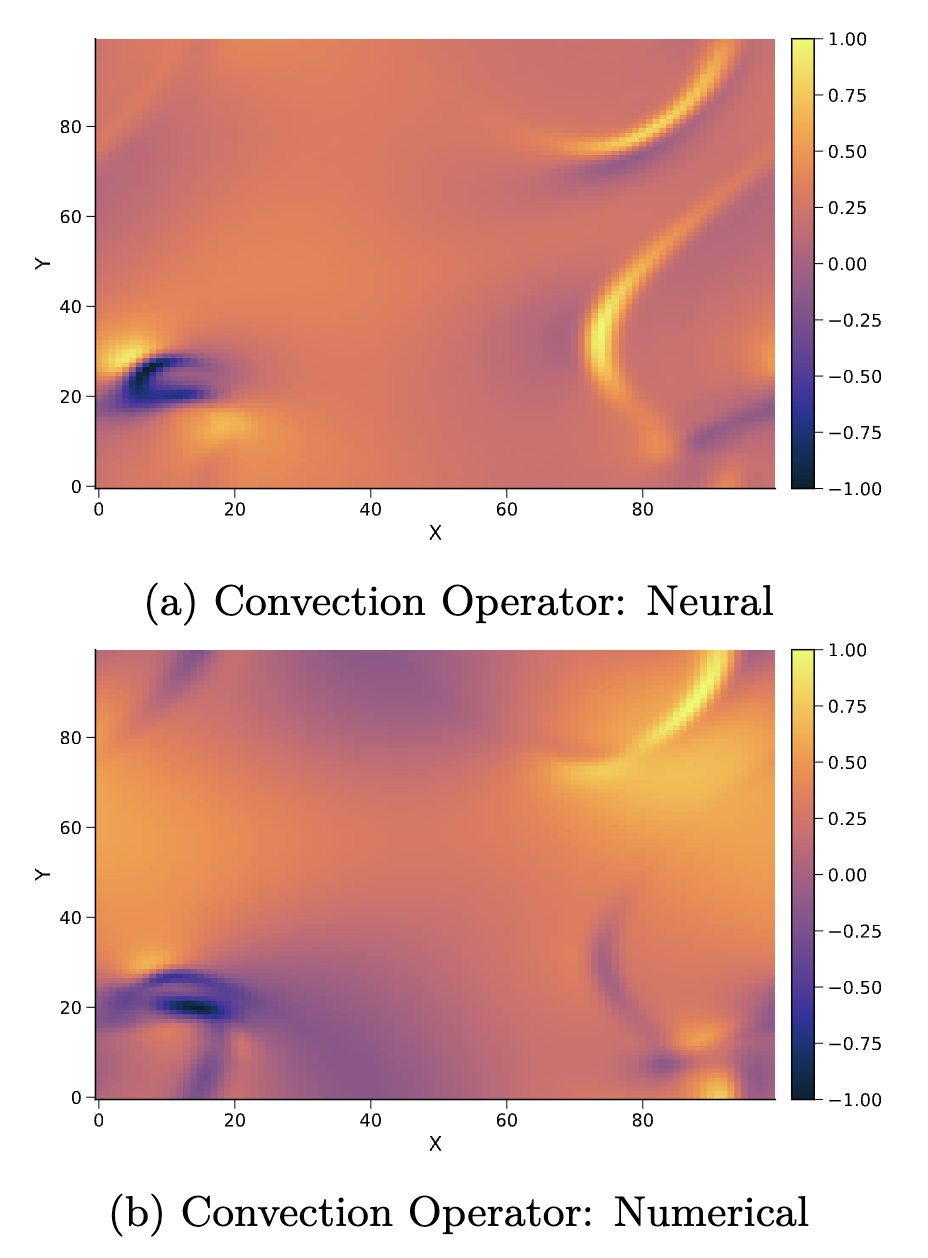
Most PDEs of interest decompose into a linear part you can write down and a non-linear part you cannot. So do exactly that: fix a linear approximation of the operator, built from the known structure, and learn only the non-linear remainder with a neural operator. Compose the two inside a Neural ODE, so the whole thing integrates in continuous time and the split holds throughout the trajectory rather than at a single step.
OpsSplit. The known physics is architecture, not regularisation. It cannot be trained away.
What it showed
Three things worth having at once:
- Generalisation to unseen physics. Because the linear operator is fixed rather than fitted, it holds outside the training distribution — the model extrapolates on the part of the dynamics that was never learned in the first place.
- Parameter efficiency. The network only has to represent the non-linear residual, which is a much smaller function than the full solution operator.
- Interpretability. The decomposition is not decorative. You can inspect what the learned component contributes over and above the known linear dynamics, which is a diagnostic you simply do not have with a monolithic operator.
Where this sits
The 2020 work learned everything from scratch and could not say how wrong it was. The UQ papers bounded the error after the fact. This one attacks the cause: stop making the network learn what we already know, and there is less error to bound.