Valid Error Bars for Neural Weather Models
ICML Workshop on ML for Earth System Modeling, 2024
Paper: Valid Error Bars for Neural Weather Models using Conformal Prediction — V. Gopakumar, J. Oskarsson, A. Gray, L. Zanisi, S. Pamela, D. Giles, M. J. Kusner, M. P. Deisenroth. ICML Workshop: ML for Earth System Modeling, 2024. · Code
The problem
Neural weather models became genuinely competitive with numerical weather prediction, and did it while dropping the one thing operational forecasting is built on: the ensemble. NWP centres quantify uncertainty by running the physics many times from perturbed initial conditions. That is expensive, and a neural model that is a thousand times cheaper per forecast loses most of its advantage if you have to run fifty of them to say anything about spread.
The idea
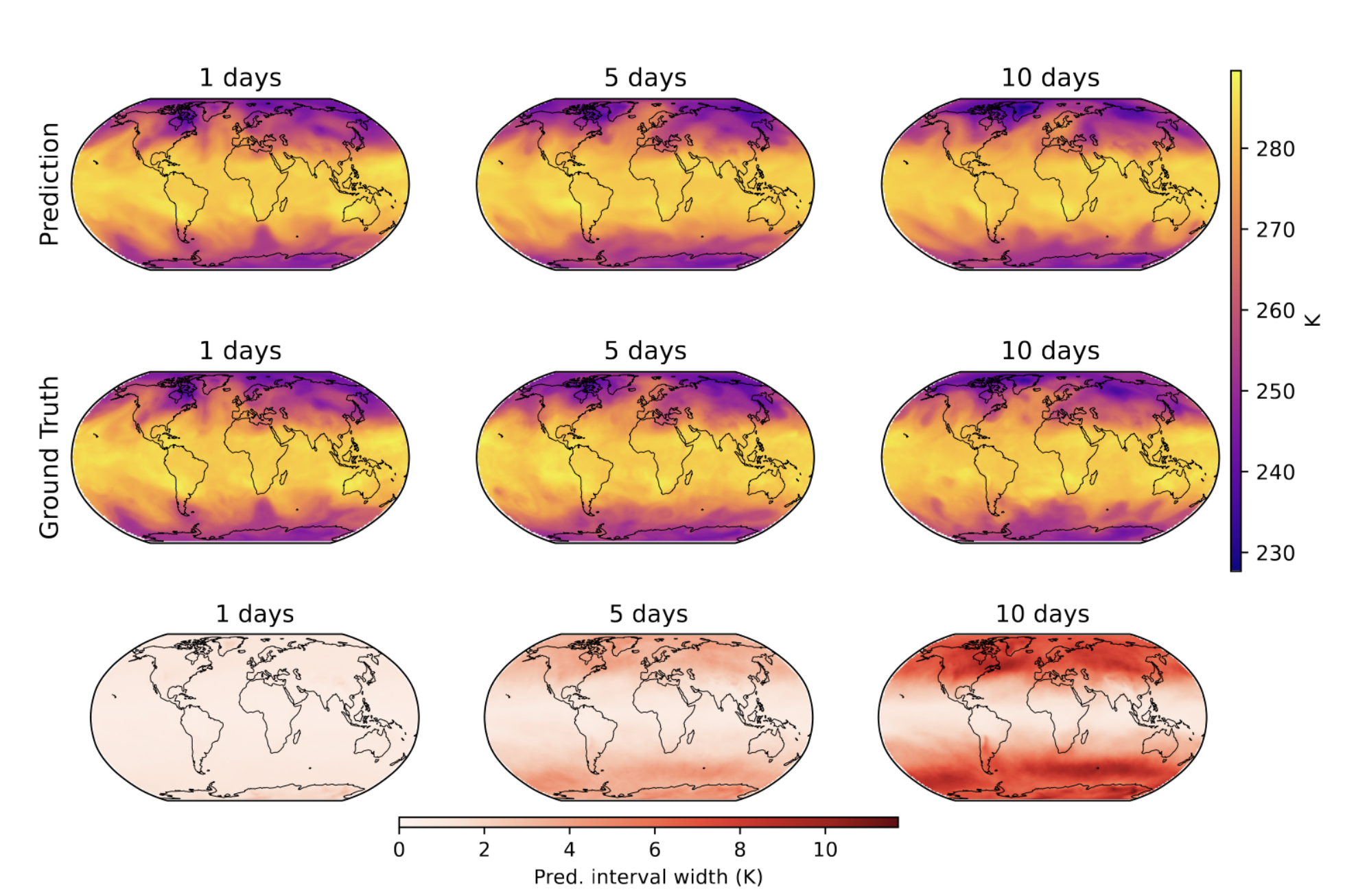
Take the conformal machinery built for fusion surrogates and point it at a neural weather model. Nothing in conformal prediction is domain-specific — it needs a calibration set and a non-conformity score, not a plasma. Applied to a graph-based limited-area weather model, it produces marginal prediction bands with coverage guarantees over the forecast domain, at the cost of one calibration pass rather than an ensemble.
What it showed
Guaranteed error bars on neural weather forecasts without ensembling. Coverage holds across variables and lead times, and the added compute is negligible next to the model itself.
Why it matters
Two reasons, and the second is the real one.
The stated reason: cheap, valid uncertainty is what a neural forecast needs before an operational centre can take it seriously.
The reason I wrote it: it demonstrates that none of the surrogate UQ work was about fusion. The argument is about neural PDE solvers in general — anywhere a network has replaced a numerical integrator and someone downstream is going to act on the output. Fusion is where I happen to work, not where the method stops.