Loss Landscape Engineering on PINNs
Machine Learning with Applications, 2023
Paper: Loss Landscape Engineering via Data Regulation on PINNs — V. Gopakumar, S. Pamela, D. Samaddar. MLA 12, 100464, 2023. · Code
The problem
Physics-informed neural networks are elegant and frequently refuse to train. The usual response is to blame capacity — deeper, wider, different activations, longer schedules. That response mostly does not work, which suggests the diagnosis is wrong.
The idea
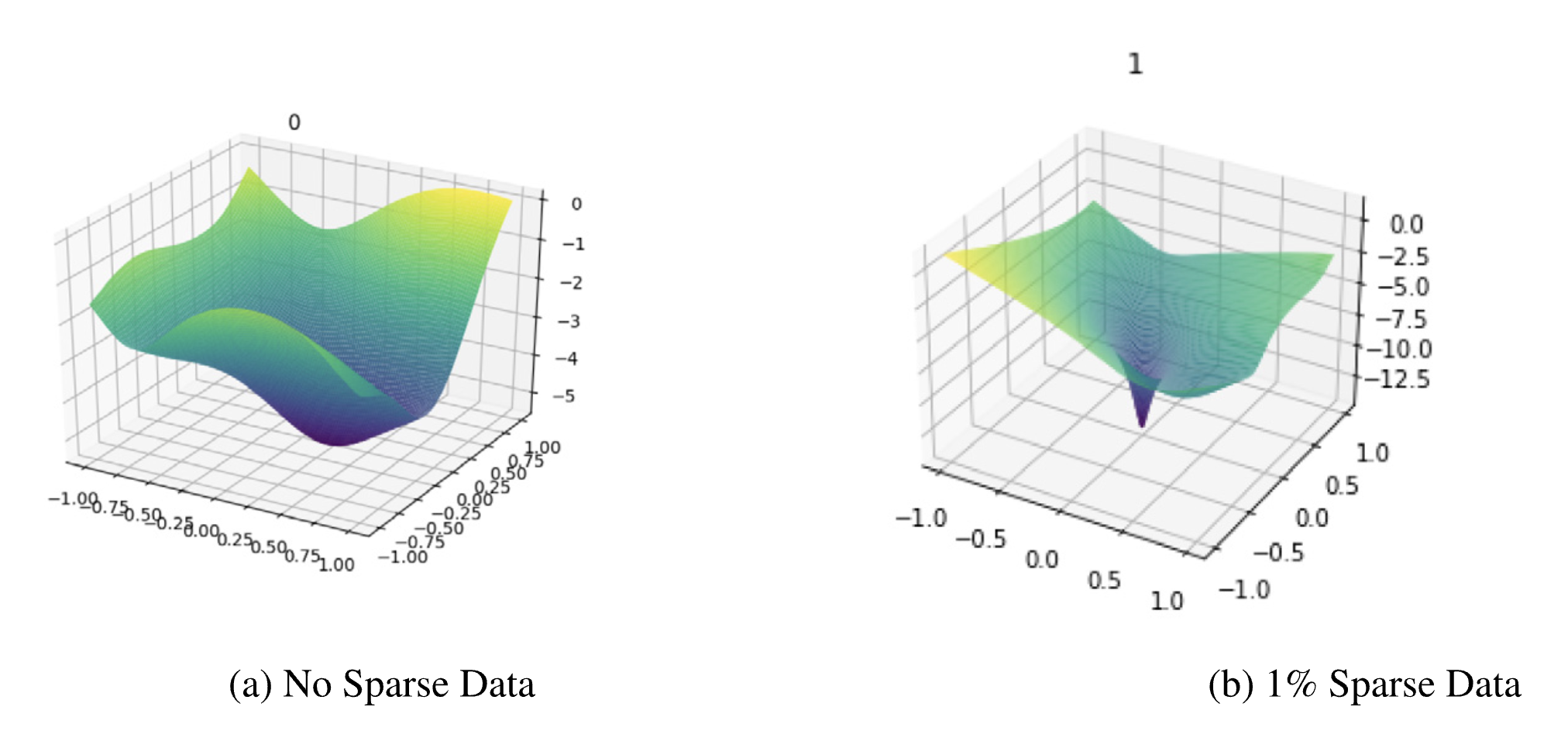
The failure is geometric, not representational. A pure PDE-residual loss produces a pathological optimisation surface: sharp, ill-conditioned, full of the kind of structure gradient descent cannot navigate regardless of how many parameters you throw at it. The network can express the solution. The optimiser cannot get there.
So regulate the loss with data. Add a controlled amount of supervised signal alongside the residual and the surface smoothens — the data term acts as a well-behaved envelope that keeps the optimiser inside a region where the residual term is informative rather than adversarial.
What it showed
Visualising the loss landscape under different data regulation regimes makes the mechanism explicit: increasing data content flattens and regularises the surface, and convergence tracks that smoothening rather than tracking model size. There is a sweet spot — too little data leaves the pathology, too much and the PDE constraint stops doing any work and you have an ordinary supervised model wearing a physics costume.
Why it matters
It reframes “PINNs are unreliable” as a solvable conditioning problem with a knob attached. It also sets up the tension the rest of the work lives in: how much of the physics do you impose, how much do you learn, and where is the split that makes the optimisation tractable. Six years later the same question shows up as operator splitting.